
Recently a visitor at Image City Photography Gallery and I had a conversation about the photos created by guest artists Michael Tomb and Marcia Zach. After viewing their images, the visitor came out of the Neuberger Gallery and said that the photos had “touched her heart and brought tears to her eyes.” We discussed how some photos seem to have a WOW factor.
So…what might make an image have that emotional effect on another person? Certainly this is very subjective because the subject matter might have a personal connection to the viewer and that connection immediately draws the viewer into the image.
Sometimes it’s the story that exists in the image. The story can be anything ranging from the spread of sprinkles sitting on top of an ice cream cone, to an incredible jagged piece of driftwood lying on a beach, to a fascinating relation between people. It might be a complex story or a simple message; for example: “those 3 weeds sticking out of the snow look so serene with the light casting shadows on the snow.”
Sometimes the story and timing are closely related as in the photo below.
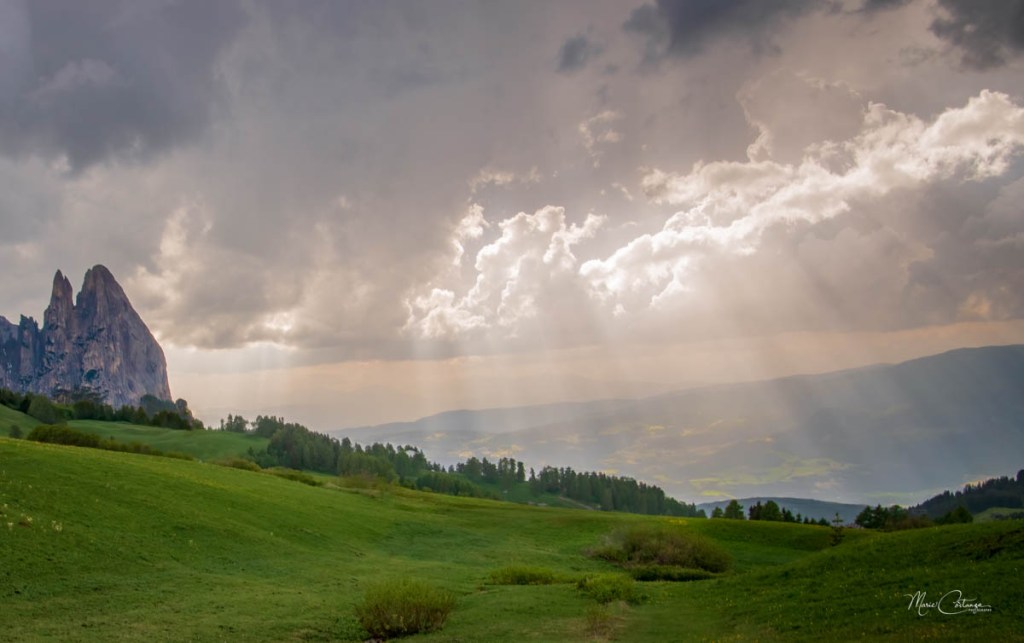
I was in the Dolomites and was awestruck by the mountains surrounding me, but on that particular morning when the sun rays were peaking out of the clouds, the scene touched my soul. Now whenever I look at that photo, I find myself back in northern Italy, where I was humming “The Hills are Alive,” and I recall that beautiful day spent with family and friends.
The timing can be a matter of capturing that instant of a second that makes a difference. You find yourself thinking, “I have to capture that magic moment!” This happened to Gallery Partner Don Menges one day when he was sitting in his home eating dinner, and he noticed the drama in the sky after a rainstorm. He simply had to leave his meal, grab his camera and go to a spot where he could capture the magic moment seen in the image below:

Another aspect about creating a WOW image might raise some discussion. If you are a strong believer in Straight Out of Camera (SOOC) photos, this point is irrelevant. If you believe in post processing, you may know that this is the part of your photography that transforms an image from flat to an image that pops. This is the phase where a photographer can make an artistic interpretation. Of course, there are certainly some aspects of processing that can actually ruin an image if one is not careful. Some of the areas that might cause problems from over processing include halos, too contrasty, and over saturation. As you process your image, you can enhance the good areas and hide the less desired parts; for example removing unwanted objects from your image. A nice side effect of improving your editing skills is that you start to pay attention to the details in your image and you start to get a better understanding of what makes a WOW photo. You might find things in your image that degrade it (eg. Why did I include that garbage can?) and learn to avoid them next time you are on location shooting. All of us can learn by making mistakes and trying to fix them.
If you would like to see how Emily Supiot from “Cozy Clicks” edits an image submitted to her by Melissa Taylor, click the link below. In the video, Emily shares her process for giving the image her interpretation of the WOW factor.
Keep in mind that in photography there are no solid right and wrongs. No two people have the same opinion; thus to some people your close-up photo of a bee hovering over a flower might be considered a WOW image, while others won’t see the attraction. Ultimately, the impact your photo has on others will depend upon their own personal experiences.
If you have created a photo that provides a WOW factor, please consider uploading it and telling us why that photo impacts you.
7 responses to “The WOW Factor in a Photo”
Straight Out of Camera (SOOC) is a noble idea but it isn’t an image that hasn’t been manipulated. Even if the photographer does no processing to the image produced by the camera, the camera’s processing engine has already applied many adjustments to what was captured such as contrast, sharpness, and brightness. The photographer can take that image data and process it further to make the image “pop,” to better reflect what he or she was feeling at the moment of capture and to better draw the viewer into that feeling. The masters at this type of processing, of taking it right to the edge but not going over the edge, are Don Menges, and Gallery friend Jim Dusen. These two well-known Rochester area photographers know just what to do to get the most out of what their cameras capture.
You are so right, Carl. Don and Jim do a fabulous job with their post processing.
Nice job again, Marie.
Now something may have been overlooked here: what is a “WOW” photograph, or what is the “WOW” factor in a photograph? Without a definition (more or less subjective of course) it might be difficult to give any definite advice. I am not sure that “a spread of sprinkles on an ice-cream” may intrinsically have a “wow” factor and tell any “story”. It sounds pretty factual and descriptive, and limited in content and meaning (as well as “story”). Maybe a complement to this blog would be to ask a-photographers what “WOW” factor they look for in their own mages (if any, as there are perfectly satisfactory photographs without a real WOW factor. At least I can think of many, and you may too), b- to ask viewers whether they look for a WOW factor in a photograph, if so what, for them, and from their experience, has had a WOW factor. What do you think?
Bruno, This is a wonderful idea. Might you consider in the future writing an article for our blog in which you describe what “WOW” factor you look for in your images, if any? In the meantime, I will ask some of our viewers whether they look for a WOW factor and get some of their input. I appreciate your feedback.
Yes why not. That would only be fair. All the best.
“WOW” factor.
What is the “WOW” factor sometimes evoked for a photograph?
Do all photographs, in the category we are interested in (amateur and fine-art) and that the gallery exhibits, require a “WOW” factor to be successful?
Again here let us strictly stick to the work that the ICPG may exhibit and start with clear definitions:
-amateur (someone who sincerely loves the medium of photography and produces photographs with various levels of proficiency and practice)
-fine-art (defined as the product of more seasoned photographers, aiming to the fine-art status implying 1-a mastery of tools (craft), 2-the expressions of concepts, emotions often implying the use of metaphors, 3-a relationship to esthetics. The crossroad of these three points being what defines fine art for me. These photographers produce on a regular basis as it is essential for them to express themselves as often as possible through the medium. They often seek exhibitions, publications, eventually sales. Printing one’s own work is also a plus, for me, as the photographers give themselves more control over the final product.
The ”WOW” factor aims for the spectacular, impact. It is often sought after in photographs entered individually in contests, exhibited in group shows. There the WOW factor is important as it helps an individual photograph to stand out for both the jury and the viewers. It may, though, too easily rely on techniques or tricks to make the image spectacular. Let us remember the (in)famous adage: “If you cannot make it good, make it big. If you cannot make it big, make it red.” To which must be added one comment by an astute student: “If you cannot make it red, make it naked!” These tricks may create a “WOW” moment for the uneducated photographer, viewer, customer. In digital photography we have seen waves of “spectacularly” first over-sharpened images, then over-saturated ones (still in fashion), then HDRed if not over-HDRed ones. The first instances of these had a WOW factor for the audience (and some photographers) that rapidly receded to the point of becoming unbearable once both photographers and viewers were educated. Then sharpening, saturating, and using HDR became more moderate and useful tools.
Nowadays there is also a movement toward a new Pictorialism, made available by image-processing applications, consisting in making a photograph look as if it were the product of a different image-making technique such as painting (use of canvas), filters and added backgrounds to make a photograph look like a print (lithograph, old collodion photograph, etching,…). These images are in fact just manipulated beyond the original photograph through the use of various programs, pre-sets, etc. … and should be called something other than photograph: digigraph, infograph… . Nothing new though, that tendency was a strong trend by the end of the 19th century and the beginning of the 20th under the auspice, in the US, of the Photo Secession. Interestingly the most prominent members (and founders) of the group moved toward straight photography by the end of the 1910s (Alfred Steiglitz, Edward Steichen,…). Even Edward Weston and Ansel Adams used pictorial techniques (among them soft-focus lenses) until the early 1920s to go to a way of using the camera that takes advantage of its specificities (detailed images (more detailed than paintings), subtlety of tones, working with the light reflected by the world around us: “straight photography” also named “pure photography”. The specificities of the medium, photography, have been easier to forget with people spending more time in front of a computer screen and with image-processing software than with their cameras. The “I press the button, and the software will do the rest” syndrome. Such image-makers may have turned from photographers into “infographers” or “digigraphers”; the question has become even more pressing with the Artificial Intelligence tools recently added to the workbench. In such cases, the “WOW” factor seems to come from the unexpected and from the mastery of tools other than the camera that can drastically modify the original photograph.
Personally, like most people, I am of course sensitive to the WOW factor of an image but that may not be what will convince me to make it, to buy it, or to display it on my wall. [By the way, this is a personal criterion I often use toward the photographs I see. It is, of course, in part subjective but it may work for you: would I hang this photograph on my wall and keep it there for months without losing any pleasure at its contemplation?
“Hay, there’s the rub!” Wow images may often not go beyond the short wow moment of first seeing them. So what am I looking for in my images as well as in other’s? Probably, as mentioned above, a certain contemplative quality that makes the moment last far beyond the wow response. I need a photograph (or any piece visual art for that matter) to take me beyond where I am, beyond what it is, and this for an experience that can last, be repeated and maybe improved as I spend more time with it. The British photographer, Bill Brandt, recognized this as what he called “atmosphere” [in Camera in London (1938)]. Yes, rather than “WOW” I also look for atmosphere. It is for me the cherry on the cake of a photograph that already shows understanding and mastery of the medium that photography is, a use of the medium that works with the content that the photographer wants to share (be it the wonders of nature, the photographer’s own emotional, philosophical, esthetic responses and considerations to the world and life).
To make my point easier to understand, here are a few examples of such images, I must confess some have a wow quality, a quiet one (which sounds like an oxymoron but is) that has lasted for decades so far : five three classics: E. Weston’s “Pepper #30”, Ansel Adams’s “Moonlight over Hernandez”, Henri Cartier-Bresson’s “Behind Gare St Lazare” (1932), André Kertész’s “Meudon, 1938” and “Mondrian’s Studio”. Then bodies of works (as groups of photographs allow the viewer to get deeper into a photographer’s psyche and esthetics (same for the author/photographer): Robert Adams’s series and book “Los Angeles Spring” or “From the Mississippi West”, Michael Kenna’s life work, Carl Chiarenza’s “Evocations” (specifically “Untitled 253”), John Pfahl’s “Altered Landscapes”, Richard Misrach’s Cantos series, Martin Parr’s “The Last Resort”, Paul Strand’s “Orgeval Garden”, Mark Klett’s “Seeing Time”, Joel Meyerowitz’s “Cape Light”, Chris Killip’s, Josef Sudek’s and Josef Koudelka’s, Joel-Peter Witkin’s (a totally different ball-game here ;o) life-works… I often value images extracted out of series as the epitome of a long-term project that let the photographer develop his ideas, emotions and responses to the world around it, giving depth to his work.
I guess I may have an idiosyncratic approach to “WOW” but it is what it is. Keep photographing!
Bruno, Thank you so much for taking the time to write such a comprehensive and thought-provoking description of your interpretation of the WOW factor. Your comments capture the essence of what makes a photograph stand out and leave a lasting effect on the viewer. Your analysis of the various elements that contribute to the wow factor are insightful and enlightening. You have certainly honed your ability to discern the extraordinary from the ordinary. Your passion for photography shines through your words, and it’s inspiring to see how deeply you appreciate the artistry and creativity that goes into capturing a truly remarkable image. Your comments have enriched the discussion and gives us a fresh perspective to consider. Thank you also for the examples and references, which are very useful, and which I believe many of our readers will find inspirational.